
5 Books You Must Read at Least Once in Your Life
5 books you must read, not to impress, but to enjoy!
We’ve all heard of the “classics” you must have read: Dostoevsky, Woolf, Proust — books that look like trophies on the shelf, but that very few people have actually read to the end. This article is not about those books.
Here you’ll find five recommendations that don’t often appear on lists of the “literary canon.” They are not necessarily “high” literature, they are not pretentious, and you certainly don’t need a degree in literature to enjoy them. They are books you start and don’t want to put down. Books you read in a café, on the subway, just before bed — not to say you’ve read them, but because they truly held you.
Yes, they may be a little guilty pleasure, but you know what? There is nothing more authentically literary than reading something that makes you feel.
1. And Then There Were None – Agatha Christie
If you’re going to read one crime novel in your life, let it be this one. I recommend it with my hand on my heart, because it is as close to perfection as the genre gets. A classic locked room mystery – ten strangers gathered on an isolated island start dying one by one in ways that resemble a children’s nursery rhyme. The murderer? One of them.
And that’s where the real game begins. Agatha Christie doesn’t just write good crime novels. She is the queen of the genre — and this is her best. The atmosphere, the pacing, and the plot twist (as they say where I come from) will make you fall in love with crime fiction, even if you thought it wasn’t “your style.”
It’s no coincidence that it’s one of the most widely read books in the world.

"Now there was only one little soldier, he went and hanged himself and there were none."
Ten strangers arrive at Soldier Island, a small island off the coast of Devon. They have all been invited to the island's only mansion by a mysterious host.
As they gather for dinner, a gramophone record begins to play, and the voice of the invisible host accuses them each of hiding their own guilty secret. Before the night is over, one of them falls dead. The others realize with horror that they are trapped on a deserted island, with a murderer among them. A murderer who is preparing to strike again… and again…
Christie's most ingeniously conceived work, translated into over fifty languages. In 2015, it was voted in an international poll as her best novel. It is the biggest bestseller in crime literature of all time.
2. The House by the River – Lena Manta
Okay, I admit it: I read it. And not just read it — I devoured it. I may be a little embarrassed to say it publicly (sorry, Lena), because you know how it is... everyone pretends to read only Kazantzakis and Hemingway, but the truth is that this book pulls you in.
Five sisters, a house by a river, a mother who raised them with everything she had, and their lives unfolding page by page with loves, mistakes, choices, and secrets. Lena Manta has this gift: she writes in a way that makes you care about the characters as if they were your friends. She doesn’t pretend, she doesn’t try to be profound — and yet, she gets you where you least expect it.
I recommend it because I enjoyed it. Because it made me remember people, situations, and feelings I had tucked away in a drawer. And because, sometimes, what you need is not a great literary epic, but a story that speaks.

Life does not end. It always flows like a river. If you don't hold the oars tightly, your boat will become a twig, drifting aimlessly in its murky waters. "Life is like the river flowing right now before us. It easily sweeps you away and pulls you wherever it goes. Just as a river doesn't turn back, neither will you, if it sweeps you away, be able to return… Always watch the river… Don't let it sweep you away…" Melissanthi, Ioulia, Aspasia, Polyxeni, and Magdalini grow up with their mother in a village on Mount Olympus, next to a river. What all five desire is to experience life away from their family home. And they will achieve it! Fate will send them to the four corners of the horizon, making the dream a reality. Only, sometimes, dreams become nightmares that haunt and chase… Five women, five stunning lives, full of love and twists, while the house by the river patiently waits for what it knows will happen.
3. When the Body Says No – Gabor Maté
One of my favorite books — and one of those you don’t easily forget. Gabor Maté has faced criticism, mainly because he links chronic stress and repressed emotional life to autoimmune diseases and other serious conditions. Personally, though, I found the book deeply illuminating.
Drawing on real patient stories and a great deal of empathy, he talks about something we all understand deep down: that our body speaks — and when we don’t listen, in the end it shouts.
Disclaimer: If you have health anxiety (I do), I’ll tell you honestly that the book mentions many serious illnesses. It may be difficult for you — but for me, it did not act as a trigger. On the contrary. I felt it helped me understand myself and my body better.
I recommend it, not because it has “all the answers,” but because it can give you some very useful questions. And that, sometimes, is the most important thing.
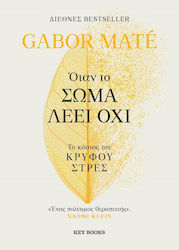
In the international bestseller When the Body Says No, Gabor Maté explains what hidden stress is, how it leads us to a series of diseases – and, most importantly, how we can heal. Can a person literally die from loneliness? Are repressed emotions linked to Alzheimer's? Is there such a thing as the "cancer personality"?
Modern scientific findings confirm ancient wisdom: emotions critically affect our health. Repressed emotions cause stress, which in turn is the root cause of many ailments.
Dr. Gabor Maté is an expert in trauma, addictions, and stress. In this work, he draws on groundbreaking research, as well as the true stories of his patients, to examine the role hidden stress plays in the onset of a series of diseases, such as heart disease, diabetes, irritable bowel syndrome, multiple sclerosis, arthritis, cancer, and a range of autoimmune diseases. Additionally, the author goes a step further by presenting the 7 Rules of Healing, which guide us from the stage of Acceptance to that of Autonomy.
With compassion and wisdom, in this book, Gabor Maté reintegrates the mind-body connection into the core of medicine and shows us how to protect our health.
4. Wild Loneliness – Kristin Hannah
Yes, Kristin Hannah has written The Nightingale, and she has also written Fireflies. But the amount of crying I did with Wild Loneliness, I have never done with any other book. We’re talking serious crying — the “I stop reading to blow my nose” kind.
And you might say: my dear, you said you were going to recommend books for us to enjoy — not to destroy us. Well, who said the one excludes the other? If a book makes you feel that intensely, then it’s doing something right.
The story unfolds in the wild, frozen Alaska of the ’70s, in a landscape that is as beautiful as it is dangerous, just like the people who inhabit it. It is a story about family, fear, love, and survival — both physical and mental.
I recommend it because it broke me apart (in the best possible way). And because it is one of those books that, when you close it, you feel like you have lived something.

A woman must be as strong as steel here… Here, you are allowed to make only one mistake. The second will kill you!" 1974. Ernt has just returned from Vietnam, where he was a prisoner of war, and cannot settle in any job. When he inherits a house in Alaska, he sees an opportunity for escape and moves there with his wife and teenage daughter. However, adapting to the new reality is difficult, even though the local community welcomes them warmly. The unbearable cold, hunger, and the permanent darkness of winter bring out the worst in Ernt, who violently lashes out at Cora, his wife. She tries tooth and nail to keep the family together and protect the teenage Leni, who, despite the harsh conditions, experiences her first love… An epic story of human survival and youthful love that blossoms against life's adversities. A novel with Kafkaesque shades, which simultaneously exudes hope and strength. #1 New York Times Best Seller from the first day of release "Combining ancient Greek tragedy with a love story like Romeo and Juliet, Hannah recreates with enchanting details the life of Alaska's inhabitants… The Great Alone is a feat!" ―Kirkus Reviews Kristin Hannah has written more than twenty novels, many of which have made the New York Times best seller list. A former lawyer who left her career to become a writer, she lives with her husband and son in the USA. Her novel The Nightingale became an international best seller with sales of over three million worldwide. You can learn more about her at www.kristinhannah.com and on Facebook.
5. Sapiens: A Brief History of Humankind – Yuval Noah Harari
I recommend it because it completely changes the way you see humanity — and yourself along with it. Harari takes all those “beliefs” we have in our heads (what is normal, what is natural, what is social, what is fantasy — spoiler: many of the things we believe are pure fantasy) and turns them upside down.
It’s a subversive look at our history, not so much as a record of events, but as a deconstruction of the beliefs that shape us — from religion to money, the state, eating habits, and why we scroll Instagram at 2 in the morning.
Extra bonus: If you’re bored of reading — okay, you’re reading the wrong article, but you never know — it also comes in a graphic novel edition.
It’s a book that opens up conversations, provokes thought, and makes you say “ah, I’d never thought of it that way”. And for me, that alone is reason enough to recommend it.

A hundred thousand years ago, at least six "human" species inhabited the earth. Today there is only one. Homo Sapiens, that is, us. How did our species succeed in the battle for dominance? How did our hunter-gatherer ancestors end up building cities and kingdoms? How did we come to believe in gods, nations, and human rights? To trust money, laws, and books? To become enslaved by bureaucracies, schedules, and consumer models? And what will our world be like in the millennia to come? Professor Yuval Noah Harari traverses the entire human history, from the first humans who walked the earth to the radical—and sometimes destructive—innovations of the Cognitive, Agricultural, and Scientific Revolutions. Drawing from a vast range of sciences (biology and genetics, paleontology and history, anthropology, sociology, and economics), he offers original, unexpected, and often entertaining answers to the most critical questions: Why were humans able to gather in astonishingly large populations, while other primate groups do not exceed one hundred and fifty individuals? Because, he says, our talent for gossip allows us to form networks in societies that would be too large for personal relationships among all their members, while the "imagined realities" we create and accept—such as money, the church, Limited Liability Companies—keep us in order. Who cultivated whom, humans or wheat? Wheat… Although the concepts are unusual and complex, Harari's skillful prose and bitter, subversive humor handle material that might otherwise lend itself to academic tedium. After all, the book often returns to another question: Does all this progress make our lives easier and us happier? The answer may disappoint you.
Relevant Articles
5 + 1 Books About the Mother-Daughter Relationship
Great Greek Authors
Browse the best young adult fiction books
Be the first to leave a comment!