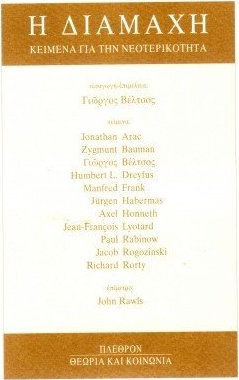
In the dispute or dialectic of modern versus post-modern, both sides are right. The case does not allow for a definitive judgment; the arguments and language games that both sides oppose are asymptotic and futile, like the announcements of couriers talking about a cloud. The pending difference is not expressed; the stakes testify that testimony is impossible; there is no foundation because we never have a foundation.
What, then, should be judged? What is judged when `the judging is this here`? Shall we assume that modern and post-modern are equivalent? That the post-modern paradoxically lies at the heart of modernity, when Mallarme announces the judgment and its judgment, urging us to judge the `very modern taste`?
Shall we think that the re-conception of truth will occur within the fleeting and in its experience, that is, in what cannot be represented? That the question of whether modernity is a `continuation` of the Enlightenment is invalid, and that the notorious dispute re-engages the old deceit of the gods, the deceit of a philosophy of the consciousness of a man in place of God?
Are we facing here the cunning of Reason and History? Are we in a Hegelian deadlock where the two terms of `opposition` taken as such justify themselves, being led? Yet, `to the same degree in error`, leaving -as in tragedy- the dispute open?
And the dispute, this reasoning but also this discourse (discursus) between modernity and itself (the post-modern), is it not the purpose (and end) of philosophy today, regarding the present for which philosophy deserves to exist?


 13 Coins
To earn Skroutz Coins, join Skroutz Plus and accept the terms of the reward program.
13 Coins
To earn Skroutz Coins, join Skroutz Plus and accept the terms of the reward program.