Scientific Books

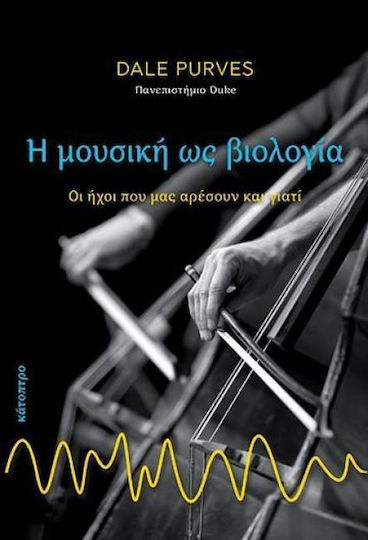
Η μουσική ως βιολογία, The sounds we like and why

Author: Dale Purves

The universality of musical tones has fascinated philosophers, scientists, musicians, and listeners for a long time. Why do people around the world find certain combinations of tones harmonious and...

The universality of musical tones has fascinated philosophers, scientists, musicians, and listeners for a long time. Why do people around the world find certain combinations of tones harmonious and others discordant? Why do we compose music using only a few scales out of billions of possible scales? Why do differently structured scales evoke different...

See full description See full description
  • Language Greek
  • Number of pages Number of pages 244
  • Cover Cover Leather
  • Year of publication Year of publication 2019
  • Publisher Publisher Katoptro
  • See all
22 19
Delivery Fri, 10 Jul - Tue, 14 Jul
5,00 € shipping cost
Sent from Greece
From Ebooks 4.9 (28)
Greece
See Books on the page of Ebooks
What if I change my mind?

No problem, as long as it's within 14 days. We'll come pick it up or you can choose the Skroutz Point that suits you, completely free for up to 2 times per year, and we'll refund your money. Get Skroutz Plus to enjoy unlimited free returns.

Description

Description

The universality of musical tones has fascinated philosophers, scientists, musicians, and listeners for a long time. Why do people around the world find certain combinations of tones harmonious and others discordant? Why do we compose music using only a few scales out of billions of possible scales? Why do differently structured scales evoke different emotions? Why do scales consist of so few notes?

In this book, Dale Purves argues that biology offers answers to these and other questions, for which conventional music theory remains silent. The voices of humans and animals consist of tonal sounds — periodic variations in air pressure that reach the ear, which, when combined, can be heard as melodies and harmonies.

Evolution has endowed humans with a tonal sense, Purves explains, due to the behavioral advantages offered by recognizing human voices and appreciating their value. Thus, our reactions to various combinations of tones can be better understood in the light of their contribution to our biological success, both during our lives and over the course of evolutionary time.

Purves presents evidence that the intervals defining Western and other musical scales have the greatest similarity to the human voice, that major and minor scales sound respectively happy or sad because they mimic lively and gentle speech in a happy and sad mood, and that the speech characteristics of a people influence the tonal characteristics of their traditional music.

Viewing music theory in the context of modern biology offers a new approach to long-standing debates regarding the organization and effect of music.

What they said about the book:

“Purves, a globally recognized expert in the neuroscience of sensory systems and a scientist known for his unconventional thinking, covers topics ranging from an overview of the human auditory system to the discussion of the emotional and aesthetic features of music in this book. [...] Its readership will not be limited to scientists, as any educated reader is likely to enjoy his book. [...]” — Donald Pfaff, Professor of Neurobiology and Behavior, Rockefeller University

“In this vivid and captivating book, Purves argues convincingly that we will never fully understand music and the ways it affects us unless we understand its ecological background and ecological origins. Background and origins, Purves argues, are rooted in human vocal communication, with the characteristics of music and our responses to them shaped by natural selection. This specific approach, supported by a comprehensively presented array of evidence, constitutes a timely complement to evolutionary approaches to the origins of music and is expected to inspire useful discussions and research. [...]” — Iain Morley, Professor of Palaeoanthropology and Human Sciences, University of Oxford.

Manufacturer

See full description

Specifications

Specifications

Author
Dale Purves
Publisher
Katoptro
Original Title
Music as Biology
Type
Humanities, Medicine - Therapies
Language
Greek
Subtitle
The sounds we like and why
Cover
Leather
Number of Pages
244
Release Date
1/2019
Publication Date
2019
Dimensions
14x21 cm
ISBN-13
9786185111847

Important information

Specifications are collected from official manufacturer websites. Please verify the specifications before proceeding with your final purchase. If you notice any problem you can report it here.

See all specifications
Questions

Questions

Do you have a question about the product?

3 users have this product and can help you

Ask for the product

Description & Specifications

The universality of musical tones has fascinated philosophers, scientists, musicians, and listeners for a long time. Why do people around the world find certain combinations of tones harmonious and others discordant? Why do we compose music using only a few scales out of billions of possible scales? Why do differently structured scales evoke different emotions? Why do scales consist of so few notes?

In this book, Dale Purves argues that biology offers answers to these and other questions, for which conventional music theory remains silent. The voices of humans and animals consist of tonal sounds — periodic variations in air pressure that reach the ear, which, when combined, can be heard as melodies and harmonies.

Evolution has endowed humans with a tonal sense, Purves explains, due to the behavioral advantages offered by recognizing human voices and appreciating their value. Thus, our reactions to various combinations of tones can be better understood in the light of their contribution to our biological success, both during our lives and over the course of evolutionary time.

Purves presents evidence that the intervals defining Western and other musical scales have the greatest similarity to the human voice, that major and minor scales sound respectively happy or sad because they mimic lively and gentle speech in a happy and sad mood, and that the speech characteristics of a people influence the tonal characteristics of their traditional music.

Viewing music theory in the context of modern biology offers a new approach to long-standing debates regarding the organization and effect of music.

What they said about the book:

“Purves, a globally recognized expert in the neuroscience of sensory systems and a scientist known for his unconventional thinking, covers topics ranging from an overview of the human auditory system to the discussion of the emotional and aesthetic features of music in this book. [...] Its readership will not be limited to scientists, as any educated reader is likely to enjoy his book. [...]” — Donald Pfaff, Professor of Neurobiology and Behavior, Rockefeller University

“In this vivid and captivating book, Purves argues convincingly that we will never fully understand music and the ways it affects us unless we understand its ecological background and ecological origins. Background and origins, Purves argues, are rooted in human vocal communication, with the characteristics of music and our responses to them shaped by natural selection. This specific approach, supported by a comprehensively presented array of evidence, constitutes a timely complement to evolutionary approaches to the origins of music and is expected to inspire useful discussions and research. [...]” — Iain Morley, Professor of Palaeoanthropology and Human Sciences, University of Oxford.

Manufacturer

Author
Dale Purves
Publisher
Katoptro
Original Title
Music as Biology
Type
Humanities, Medicine - Therapies
Language
Greek
Subtitle
The sounds we like and why
Cover
Leather
Number of Pages
244
Release Date
1/2019
Publication Date
2019
Dimensions
14x21 cm
ISBN-13
9786185111847

Important information

Specifications are collected from official manufacturer websites. Please verify the specifications before proceeding with your final purchase. If you notice any problem you can report it here.

22,19 €
5,00 €   shipping cost