

Which Dog Leash Should You Choose? Everything You Need to Know!
Type, length, material, and width: what to check before choosing a leash for your dog.
A dog leash seems like the simplest purchase, until you see how many types, lengths and materials there are. The one you’ll hold on every walk should suit your dog’s size, the places you walk and the way you move.
We’ll start with the type and work our way through the details, so you can quickly find the right one for you. Let’s take a closer look at everything and answer all your questions!
1. Type: classic, retractable or hands-free?
The first decision is how you want to walk together. This determines the length, material and other details to consider.
- Classic leash. It has a fixed length, usually 1 to 2 meters, and no mechanism that could break. Its fixed length keeps your dog by your side on sidewalks and busy streets. On the other hand, it doesn’t give your dog room to wander farther when there’s space.
➡ Choose this if: you mostly walk on streets and sidewalks and want maximum control.
- Retractable leashes have a strap or cord wound inside a handle, with a brake button. The leash extends as far as you want and locks at the length you choose, so your dog can explore in the park and stay close on the street. Each model lists the maximum dog weight it can handle in its specifications, e.g. 12, 25 or 50 kg.
➡ Choose this if: there’s a park or open space nearby where your dog can wander a little.
- Hands-free leashes are worn around the waist and often have a shock absorber built into the leash. Your hands stay free for running or carrying something else, and many models have a pouch for waste bags. If your dog suddenly takes off, you’ll feel the pull at your waist, so a shock absorber makes a difference.
➡ Choose this if: you run or walk with your hands full.
SkroutzTip: For retractable leashes, choose a model with a weight limit higher than your dog’s weight. You’ll find the limit in the product specifications.
2. Length: how far will your dog go?
The length determines how much freedom you give your dog and how much control you keep. You don’t need the longest leash, just one that suits the places you go.
- Up to 3 meters. This is the most common choice for everyday walks. Your dog stays by your side and has enough room to sniff along the sidewalk or at a street corner.
- Leashes from 4 to 8 meters are mostly retractable, with 5 and 8 meters being the most common lengths. At the park or in the countryside, your dog can move around comfortably, and you can use the brake to reel them in when people or cars pass by.
- Long leashes of 9 meters or more are mainly used for training and tracking, with lengths such as 10 or 15 meters. They usually don’t have a retraction mechanism: you gather the leash by hand and adjust the distance as needed. They require an open space with no traffic nearby.
➡ Choose a long leash if: you’re practicing recall (“come here”) in a field, on the beach, or in a large open space.
SkroutzTip: Think about where you’ll use it most. On the sidewalk, you’ll usually keep the leash locked at a short length, so a medium-length leash is enough.
3. Training: do you need a special leash?
You can use a regular leash or a special one for training. The difference lies in the length, the attachment points, and how easily you can adjust the distance while on the move.
- A regular leash is enough to teach your dog to walk beside you, since that’s exactly what you practice on your daily walks.
- Training leashes usually have an adjustable length, with multiple rings or attachment points. Shorten the leash on the street and lengthen it at the park without changing leashes. This category also includes the long recall leashes we looked at above.
➡ Choose a special leash if: you’re working on specific commands, such as recall or walking beside you, and want to adjust the length while on the move.
SkroutzTip: An adjustable leash with rings can also do the job of a regular leash, so you don’t need two.
4. Material: webbing, leather or chain?
The material determines how heavy the leash feels in your hand, how it holds up in the rain and how well it withstands chewing.
- Webbing (fabric or synthetic) is the most common choice. It’s lightweight, flexible and available in a wide range of colors and widths. It’s easy to clean and feels light in your hand. If your dog chews the leash, webbing is the material that wears out most easily.
- A leather leash feels sturdier in your hand and softens over time. If it gets wet often, it needs to be dried and cared for, as leather doesn’t hold up to rain or seawater like webbing does.
- Finally, chain leashes can withstand a dog biting the leash, since teeth can’t cut through metal. However, they’re heavier and colder to hold, so look for a model with a fabric or leather handle.
➡ Choose a chain leash if: your dog chews the leash and fabric ones don’t hold up.
SkroutzTip: Check each product description for the exact material of the leash itself, as well as the handle and clasp.
-
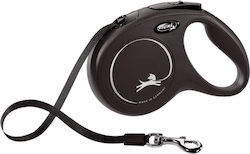 View Straps
-
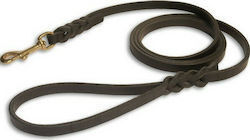 Shop Leather Straps
-
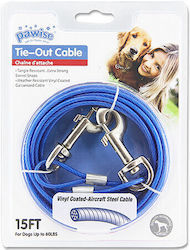 Shop Chain Belts
5. Leash width & strength: is it suitable for your dog’s size?
The leash should withstand your dog’s strength and feel comfortable in your hand. Leashes typically come in widths ranging from around 10 to 25 mm.
- As a general rule, narrow widths (10–15 mm) are suitable for small dogs and are lighter.
- Wider widths (20–25 mm) are suitable for larger, stronger dogs and are more comfortable to hold when your dog pulls.
Many products also state the maximum dog weight they can support, e.g. up to 15 or 25 kg. Compare this with your dog’s weight before buying. Also check the hook and handle: a secure metal hook and a padded handle make walks more comfortable. Reflective stitching helps when you’re out walking after dark.
SkroutzTip: If your dog is still growing, choose a width suited to the size they’ll be in a few months, rather than their current size.
Don't forget! By considering the features above and choosing the ones that suit your walks and your dog, you can find the perfect option. Before you decide, take a look at other users' reviews to learn about their experiences, which may help you make your choice much more easily.
Also, discover the best dog leashes for every use on Skroutz.
This article was created with the help of AI and reviewed and edited by the Skroutz team.
Relevant Articles
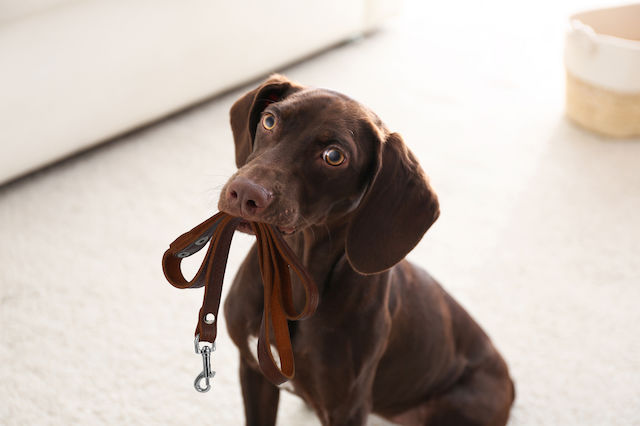
The Best Dog Leashes for Every Need

Travel & Dog: The Essential Checklist!

The Best Dog Supplements for Every Need
Be the first to leave a comment!