

Which Outdoor Heater Should You Choose? Everything You Need to Know!
Gas or electric? Mushroom or tower? Learn how to choose an outdoor heater based on its type, power, IP rating, and safety features.
Outdoor stoves and heaters may seem straightforward, until you see how different the models are: some run on gas, others on electricity; some heat the area all around them, while others direct heat in just one direction.
The right choice depends on your space and how you plan to use it: a yard, a covered terrace and a pergola each call for a different solution. Let’s go through all the criteria one by one to answer any questions you may have!
1. Power source: Gas or electricity?
This is the first decision to make, as it determines everything else: the heater’s power, shape, and where you can set it up. It depends on whether there’s an outlet where you plan to place the heater and how large an area you want to warm.
Gas heaters don’t need an outlet and provide plenty of heat, usually 11 to 13 kW for freestanding models. They run on a gas cylinder that you buy and replace yourself, and need open space around them. That’s why they’re a good fit for large yards and open areas.
➡ Choose one if: you want to warm a large area or don’t have an outlet nearby.
Electric heaters don’t need a gas cylinder and can be switched on with a button or, on many models, a remote control. They have a lower output, usually 1.5 to 3 kW, and warm a small area, such as a table or seating area. They need a nearby outlet.
➡ Choose one if: you have an outlet where you sit and want to warm a small group of people.
You can see a brief comparison in the table below:
2. Type: Which shape suits your space?
The type determines how the heat is distributed: around the heater or in one direction. It depends on how people are seated (around a table or in a row) and how much height you have available.
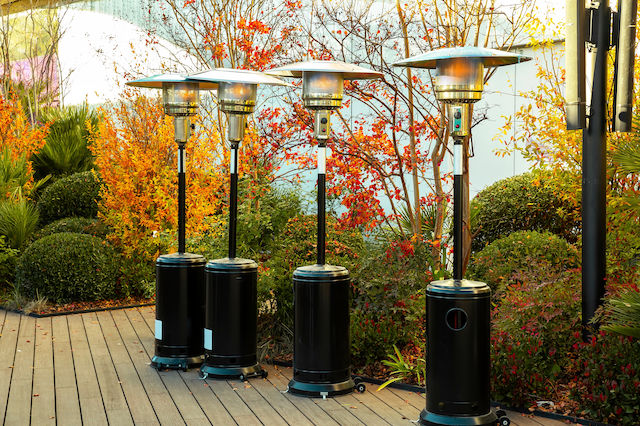
- The mushroom heater is a column with a hat-shaped reflector at the top that directs heat downwards and all around. It is the classic choice for patio tables.
- The tower heater is a tall cylindrical tube, usually 1.2 to 2.1 m high, that heats the entire area around it and is suitable for spaces where you want to cover a wider radius.
- The pyramid heater is a freestanding heater with a pyramid shape and a visible flame, which also adds a decorative touch to your space.
- The heater with a stand stands upright on a base, so you can move it wherever you are sitting.
- The reflector heater is a flat panel that emits heat in one direction. Reflector heaters are available in both gas and electric models.
- Finally, the pinecone heater is a small, portable gas heater with low output (usually around 2–3 kW), for small spaces or trips.
➡ Choose a mushroom or tower heater if: you want to heat a group of people sitting around a table or in a large patio.
➡ Choose a reflector heater if: everyone is sitting opposite the same point, for example in a row of benches.
SkroutzTip: Tall models reach or exceed 2 metres. Before ordering, measure the height of your canopy or pergola to ensure there is enough clearance above the heater.
3. Placement: On the floor, wall, or ceiling?
It depends on whether you have free floor space and where you can safely secure the heater.
- Freestanding heaters are the most common choice. They don’t need to be mounted, and you can move them wherever you like, as long as there’s enough clear space around them.
- Wall-mounted heaters, on the other hand, are fixed to a wall and leave the floor clear, which is useful when space is limited. You’ll need a sturdy wall at the right height.
- Finally, ceiling heaters hang overhead and heat downwards without taking up any floor space. They’re suitable for covered areas with an appropriate support.
➡ Choose wall-mounted or ceiling heaters if: space is limited or lots of people pass through and you don’t want obstacles on the floor.
4. Heating technology: Infrared, quartz or ceramic?
These technologies are mainly used in patio heaters and electric heaters, and determine how the heat reaches you.
- Infrared heaters heat objects directly rather than the air, so you can feel the warmth even when there is a breeze.
- On the other hand, halogen-quartz heaters use bulbs that heat up quickly and also emit light, which may bother you if you’re sitting opposite them.
- Ceramic heaters heat up using ceramic plates, without emitting bright light. They’re available as both electric models and gas patio heaters. If you’re sitting nearby and don’t want a bright light shining in front of you, they’re an ideal choice.
Discover Infrared Heaters for Better Heat Distribution


5. Power & room coverage
Power, measured in kW, indicates how much space the stove can heat. The larger and more open the space, the more kW you need, and the closer you sit, the fewer you need.
The table below shows the approximate area covered by each power rating:
SkroutzTip: The prices are indicative. Outdoors, wind and whether the area is sheltered can significantly affect the results, so if your space is open on several sides, choose a slightly higher output.

6. Protection against water and dust (IP)
An outdoor electric heater will inevitably be exposed to moisture, dust or rain. The IP rating indicates how well it is protected against these elements and is defined by the IEC 60529 standard. The first digit refers to dust and solid objects, and the second to water. For each digit, the higher the number, the greater the protection.
You can see the comparison in the table below:
SkroutzTip: Not all products display an IP rating. If it’s missing, check the manufacturer’s instructions to see where the device can be installed, and choose a sheltered location.
7. Practical features that make a difference
Once you’ve decided on the essentials, a few extras can make everyday use easier:
- A heater or stove with a remote control lets you adjust the heat output without getting up. Handy when the appliance is mounted high up or on the ceiling.
- Also, a portable outdoor heater on wheels can be easily moved from one corner to another, even if it’s heavy.
- Meanwhile, a stove with piezoelectric ignition can be lit at the touch of a button, without a lighter or matches.
8. Gas cylinder, installation & safety
If you choose a gas heater, it’s worth knowing what you’ll need and how to use it safely.
- Gas cylinder and consumption: freestanding models with an output of 11–13 kW consume approximately 800 to 945 g per hour at maximum power. This means a 10 kg cylinder lasts around 10 to 12 hours. Check the specifications to see which cylinder the model is compatible with.
- For outdoor use only: these heaters are designed for use in open, well-ventilated areas. Combustion produces carbon monoxide, so never use them inside a home or tent.
- Keep away from flammable materials: keep the heater at least 1 metre away from curtains, furniture, firewood and other flammable materials. Place it on a stable, level surface.
- Check before each use: make sure the hose and regulator are not damaged. Choose certified appliances and follow the manufacturer’s instructions.
- Wind: strong winds can affect the flame and the heater’s stability, so take care where you position it.
SkroutzTip: If you’re unsure how to connect the gas cylinder, ask someone who knows how to do it.
Don't forget! By considering the features above and combining those that suit your space and needs, you can find the ideal option. Before you decide, take a look at other users' reviews to learn about their experiences, which may help you make your choice more easily.
Gas heaters are intended exclusively for use in open, well-ventilated areas and must always be used in accordance with the manufacturer's instructions. Consult an authorized technician for connecting and installing the gas cylinder.
If you still haven’t settled on the ideal option for yourself, you can also check out the guide to the best outdoor stoves and heaters for every use.
This article was created with the help of AI and reviewed and edited by the Skroutz team.
Relevant Articles
The Best Outdoor Stoves & Heaters for Every Use
Which Instant Water Heater Should You Choose? Everything You Need to Know!
The Best Oil-Filled Radiators for Every Room
Be the first to leave a comment!