

Kitchen Hood Buying Guide
Your essential ally for cooking without strong odors and steam!
Are you in the process of renovating or buying a new range hood for your kitchen? Are you considering all the factors you need to take into account, such as the technical specifications, the type of kitchen and hobs, the available space for installation, the performance of the range hood, as well as the aesthetics your kitchen will have?
Let's go through all of the above in detail, so you can make the ideal choice for you.
1. Type
Kitchen hoods are available in various types, based on their installation method and functionality. So, choose a hood that matches your kitchen layout and the aesthetics of your space, but is also practical and efficient. Let's look at the different types and in which cases each is recommended.
- Free-standing Hoods: These are hoods that can be mounted on the wall by themselves, without the presence of a cabinet. They are simple in design and represent a more traditional method of extraction.
Find Ductless Range Hoods:


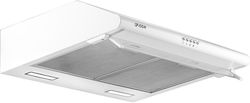


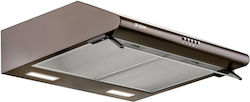

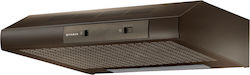

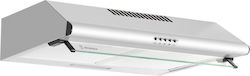
- Chimney Hoods: Installed on the wall and feature a chimney that expels air outside the house. They are suitable for larger kitchens and add an impressive element to the space's design.
Find wall-mounted range hoods (chimney):


- Island Range Hoods: They are designed for kitchens with an island, from which they get their name, and are installed on the ceiling above the stove, requiring special installation. They are ideal for open cooking spaces in large kitchens.
Find ceiling (island) range hoods


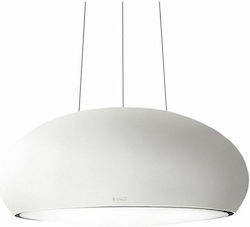
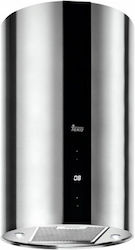

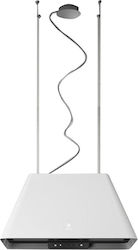

- Built-in Range Hoods: We usually refer to extraction mechanisms, sliding or retractable range hoods, which are installed inside cabinets, offering a discreet appearance and space-saving. They are ideal for kitchens with limited space or for those who desire a uniform and minimal aesthetic.
Find built-in range hoods:
-
 Sliding
-
 Folding
-
 Absorption Mechanisms


2. Size
The size of the cooker hood is another parameter you should take into account when making your choice. It is important that the cooker hood fully covers the cooking surface for optimal performance. So make sure that it fits the dimensions of your kitchen and, in particular, that it matches the width of your hob. Usually, we find cooker hoods with a width of 60 cm or cooker hoods with a width of 90 cm.
3. Suction Power
Suction power is measured in cubic meters per hour (m³/h) and determines the hood’s ability to remove steam and odors. Choose a hood with enough power depending on the size of your kitchen.
As a guide:
- for spaces up to 13 sq.m. you need a hood with low power (up to 350m³/h),
- for spaces up to 20 sq.m. you need a hood with medium power (351 - 550m³/h) and
- for larger spaces of 21 sq.m. and above you need a hood with high power (551m³/h and above).
Calculation
A general rule is that the hood should recirculate the kitchen air 10 times per hour. To calculate the ideal power for your space, you can use the formula below:
- Suction Power (m³/h) = Kitchen Area (m²) × Kitchen Height (m) × 10
For example, a 12 sq.m. kitchen with a height of 2.5 m requires a hood with power: 12 m² × 2.5 m × 10 = 300 m³/h.

4. Air Function
The air function in a range hood reflects the way the device manages the air it collects. There are two basic air operation options in range hoods:
1. Air Extraction (External Ventilation)
In this mode, the range hood removes air, vapors, odors, and grease from the kitchen and channels them outside the house through a ventilation duct. This effectively achieves the removal of odors, moisture, and smoke, while active carbon filters are not required. However, proper installation with ventilation ducts is needed, which can be difficult in some homes or apartments.
2. Air Recirculation (Internal Ventilation)
In this mode, the range hood filters the air it collects (through grease and active carbon filters) and returns it clean back to the kitchen. Such a range hood is easier to install, as ventilation ducts are not required, making it ideal for spaces where their installation is not possible. However, it requires good maintenance and regular replacement of filters, as we will see below. Such range hoods may be less efficient in removing moisture and smoke compared to those with air extraction function.
Find range hoods based on air function:
SkroutzTip: You can also find range hoods with extraction or recirculation function, so you can choose how you want to operate your appliance. These range hoods are useful if, for example, you move often and do not know whether the next house you move into has an installation for duct connection.
5. Filters
Filters are the "heart" of a cooker hood, and for this reason you should make sure regularly that they are working properly, clean them and take care of them, so as to ensure a longer lifespan and replace them whenever needed.
But what are the available types of filters?
- Carbon filters: These are advanced technology filters used in air recirculation models to absorb odors. They are not washable but must be replaced every 3-12 months, depending on use and filter quality.
- Metal filters: They are easier to remove and clean. They do not need frequent replacement, only cleaning every 1-2 months, depending on how often you cook. They can be washed by hand with warm water and soap or in the dishwasher.
- Acrylic filters: These filters are made of solid acrylic material, are easy to wash, and need more frequent replacement than metal ones, every 3-6 months, depending on use.
SkroutzTip: Choose a cooker hood with a filter cleaning indicator and you will never forget to clean them.
6. Noise level
The noise emitted by a range hood during operation is measured in decibels (dB). Noise levels below 60 dB are considered acceptable for home use. So, if quietness is a priority for your space, choose a range hood with a low noise level, so it won’t be disturbing during use and cooking can become even more enjoyable.
7. Energy Efficiency

The information displayed on the energy label of a kitchen hood, along with the filters on our page, can guide you to understand how much electricity it consumes when in use. Indicatively, the letter A indicates the lowest possible consumption.
The other details found on the energy label are:
- The supplier's name
- The model of the specific product
- Additional information about the device's features
8. Extra functions & features
Some hoods offer additional functions, such as:
- Smoke sensors: Hoods with such sensors automatically detect smoke levels and adjust the power accordingly. So, you don’t need to worry about increasing the hood’s intensity, as it handles everything on its own.
- LED lighting: LED technology provides better illumination of the cooktop with low energy consumption. Ideal for new homes and modern spaces.
- Timer function: Hoods with a timer function allow you to schedule their operating duration. It is a very convenient feature when you want to leave the house, but don’t want to leave the smells and odors behind.
8. Aesthetics & Design
What to consider before choosing?
- Material: Stainless steel, glass, or other materials can affect appearance and maintenance.
- Style: Depending on the aesthetics of your space, choose a hood that matches the style of your kitchen.
- Lighting: Prefer a hood with built-in lighting for extra brightness over the stove.
- Speeds: Choose a hood with multiple speeds for different cooking levels.
- Color: Choose a color that harmoniously matches the other elements of your kitchen.
9. Installation & connection
Proper installation of the extractor hood is essential for its effective operation and long-term performance.
What are the factors you should pay attention to?
- Installation height: For use with electric hobs, the distance between the hob and the extractor hood should be 65-75 centimeters, while for use with gas hobs the distance should be 75-85 centimeters. If the extractor hood is installed lower, there is a risk of overheating or damage to the extractor hood, while if it is installed higher, its suction capacity may be reduced.
- Air operation: For extractor hoods with extraction mode, it is advisable to use ventilation ducts with a diameter of at least 150 millimeters, with no many bends, installed in a straight line. Whereas, for extractor hoods with air recirculation, make sure the filters are installed correctly.
- Stability: For wall installation, you need to make sure it is suitable, especially in older homes; for cabinet installation, make sure it can support the weight of the extractor hood, while for ceiling installation special support is required.
Find more information about the installation and connection services, which we offer at Skroutz!
Don't forget! By taking into account the above individual characteristics and combining those that suit your needs, you can arrive at the ideal choice for you. Before deciding, you can also take a look at the reviews of other users, to see their opinions and experiences, which can help you reach a final decision much more easily.
You can also take a look at the guide to the best kitchen hood options, where you will find the best ones based on user feedback.
Relevant Articles

The best kitchen hoods

The Best Freezers on the Market
Buying guide for choosing the right freezer
Be the first to leave a comment!