

Yes to the sun? YES to sun protection!
What is the first thing that comes to mind when you hear the word "sun"?
Sea, holidays, maybe friends, family, and loved ones.
All hide joy and carefreeness.
But how can you continue to enjoy the sun and the carefreeness of summer days while protecting your skin from the harmful effects of solar radiation?
With the right sun protection!
Why is the use of sunscreen important?
Because, in short, sunscreen is the shield of protection against solar radiation!
Especially in recent decades, due to environmental pollution and specifically the ozone hole, exposure to solar radiation carries many health risks: from a simple burn or irritation to dark spots, premature aging, and cancer.
The most important problem that arises over the years, however, is skin cancer. The reduction of ozone has significantly intensified the problem, leaving us more vulnerable and exposed to serious skin conditions.
-
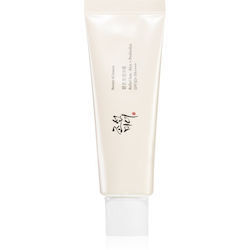 Facial Sunscreens
-
 Body Sunscreens
-
 Children's Sunscreens


What is the difference between sunscreens with physical and chemical filters?
Physical filters are those that reflect solar radiation and contain natural oils, such as zinc oxide. On the other hand, chemical filters absorb solar radiation. Both filters have the same effectiveness, they just work in different ways. If you haven't tried any sunscreen before, then do a patch test!
Before applying the sunscreen normally, you can test it for a few days on a small area of your skin. This way, if you have sensitivity to any substance, you will avoid irritation on your entire face or body!
Composition of Sunscreen Products
You can find sunscreen products in the form of cream, stick, and mist. The most common choice is the cream, while if you have oily skin, lighter textures like spray are usually the best options for you!
-
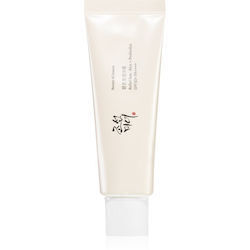 Sunscreen in Cream
-
 Sunscreen in Stick
-
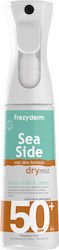 Sunscreen in Spray

Proper Use of Sunscreen Products
Facial and body sunscreens are recommended to be applied half an hour before sun exposure and should be reapplied immediately after each swim, always depending on the SPF, which indicates the duration of protection.
How? Read the example below!
If, for example, your skin burns after 5 minutes of sun exposure, with a sunscreen with SPF30, you have 30 times more sun protection, thus 150 minutes of protection!
Sunscreens for Hair
Beyond the body and face, hair also needs sun protection and care. The sun, heat, and sea make it dull and dehydrate it, resulting in it breaking very easily and developing split ends in no time. Apart from hats and scarves, which offer protection, there are special hair sunscreens in various forms, such as sprays, lotions, creams, masks, which hydrate and protect from solar radiation.
Hair Sunscreens


Sunscreens for Lips
Equally important is the protection of the lips from solar radiation, as lips contain very little melanin and thus have limited defense against the sun. You can find several products in stick form that prevent dryness and spots on the lips!
Lip Sunscreens


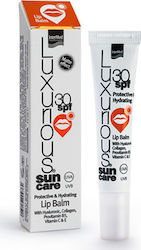

Children & Baby Sunscreens
Infants up to 6 months old should not be exposed to the sun, not even under an umbrella, because their skin is extremely sensitive. For older children, it is recommended to expose them to the sun after 4:00 PM, when the sun is in a lower position.
The sunscreens we should apply to young children are of high protection factor, with physical filters that reflect solar radiation (UVA). The most common form is that of a lotion, which leaves a white film on the skin. Application should be done half an hour before sun exposure, as with adults, and reapplication should be done at frequent intervals.
Children's Sunscreens


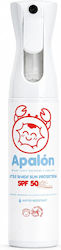


Baby Sunscreens


After the sun, what?
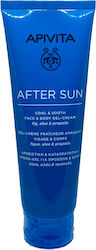
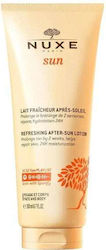
After sun! After sun products relieve any irritations, redness, and burns that the sun may cause, while hydrating and restructuring the skin. Their composition soothes irritations and inflammations and is more effective than regular body creams for burns.
After Sun



Glossary: Terms you may come across and should know
You may come across the following terms on labels and advertisements of sunscreens:
UVR: Ultraviolet solar radiation, which is divided into UVA, UVB, and UVC, depending on the wavelength.
UVA rays: Ultraviolet radiation responsible for skin aging, because it affects the cells that produce elastin and collagen. It penetrates deeper into our skin and increases the risk of skin cancer. Its effects are present throughout the day, all year round.
UVB rays: Ultraviolet radiation responsible for sunburns, which, when repeated, can cause skin cancer. These rays stay on the surface of the skin and produce melanin. Their effect is more intense in summer and mainly during midday hours.
-
SPF (Sun Protection Factor): Used to describe the level of protection a sunscreen product provides against the sun’s harmful UVB radiation. The number corresponding to the SPF indicates how many times longer someone can stay in the sun without burning, compared to the time needed to burn without sun protection.
For example, if your skin needs 10 minutes to burn in the sun without sun protection and you use a sunscreen with SPF 30, then you can stay in the sun for 300 minutes (10 minutes x 30) before burning.
PA & PPD: These are the two indicators that refer to the protection a sunscreen offers against UVA radiation. The PPD index is measured in numbers, while PA is measured in plus signs. Thus, 3 levels are distinguished:
Low UVA protection: PA+ = PPD 2-4
Moderate UVA protection: PA++ = PPD 4-8
Satisfactory UVA protection: PA+++ = PPD 8 and above
Broad-spectrum sunscreens: Those that protect us from UVA & UVB rays.
Relevant Articles
Sunscreen Buying Guide: Find the right one for you!

Head to Glow: Glow from Head to Toe
Skinimalism: The new beauty trend that loves the simple and effective
Be the first to leave a comment!