Agelos Vlachos
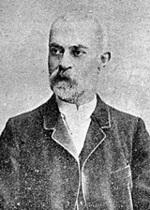
Angelos Vlachos was born in Athens, the son of Stavros Vlachos and Sofia Trikkalianou. He studied at the Law School of the University of Athens, graduating in 1859, and in 1861 he went to Germany for further studies, staying there until the expulsion of King Otto. Upon his return to Athens, he worked at the Ministries of Ecclesiastical Affairs and Public Education (1863 and 1895). He also served as the head of the Department of Foreign Affairs in the first government of Charilaos Trikoupis, participating in the Berlin Conference of 1878 and later becoming the general secretary. He was a Member of Parliament for Attica with Trikoupis' party in 1885, ambassador to Berlin from 1887 to 1890, and governor of Corfu in 1893. He played a decisive role in the establishment of the Royal Theatre, although he was forced to resign before its opening and later managed it from 1905 to 1906, during which time he was also the general director of Greek Telegraphs and Post Offices. He passed away in Athens. Vlachos collaborated with many Athenian newspapers and magazines of his time, including "Efimeris ton Philomathon," "Aion," "Kairoi," "To Asty," "Akropolis," "Avgi," "Asmodaios," "Efimeris," "Elpis," "Stoa," "Pandora," "Chrysallis," "Ilissos," "Parisini Echo," "Parnassos," "Estia," and others. He engaged in poetry, prose, theater, essays, criticism, and philology. In prose, Angelos Vlachos began his literary journey within the romanticism of the First Athenian School but quickly turned towards a realistic depiction of daily life in Athens, which was then in the early stages of urbanization. Supporting his view on the decline of Western civilization, Vlachos promoted an idealistic, Hellenocentric worldview in poetry, a stance that led to his famous critical dispute with Emmanouil Roidis in 1877, sparked by Roidis' proposal in that year's Parnassos poetry competition. His trajectory in theater was similar, where he was one of the proponents of a shift towards ethnography and advocated for the creation of a national comedy genre, combining satirical portrayals of contemporary figures and situations with clear didactic intentions. Overall, Angelos Vlachos is considered a precursor to the literary generation of 1880. In terms of language, he adopted the simple Katharevousa, which he deemed the ideal solution in the debate between archaists and supporters of Demotic Greek.
 Poetry Books
 Greek Fiction Books