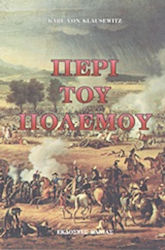
Karl Von Klausewitz
Carl von Clausewitz (1780-1831) was a military officer and war theorist who emerged during the era of enlightened absolutism in the Kingdom of Prussia, characterized by a high-level bureaucracy and a powerful army. He was born with the full name Carl Philipp Gottfried von Clausewitz in the town of Burg in Western Prussia, near Magdeburg. He came from a middle-class family, with a father who was a retired colonel. Following in his father's footsteps, young Clausewitz joined the Prussian army at the age of 12 as a cadet. In 1801, he entered the Military Academy in Berlin (graduating in 1803), where he studied military art under the guidance of Gerhard von Scharnhorst, explored philosophy and philology, and developed his foundational military concepts. In 1806, he participated in the Jena campaign and was captured as a prisoner in Breslau. He returned to Prussia two years later, where he was appointed as a section chief in the Ministry of War and took an active role in the reorganization of the Prussian army under Minister Scharnhorst. In 1810, he was appointed as a professor at the Military Academy in Berlin, close to the Prussian crown prince. Two years later, he resigned from his position and joined the Russian army to fight against Napoleon. In 1814, he returned to the Prussian army, distinguishing himself in battles against Napoleon's French forces, eventually reaching the rank of chief of staff of the Prussian forces at the Battle of Waterloo, which determined the fate of the French commander in 1815. In 1818, at the age of 38, Clausewitz was promoted to major general and appointed director of the Military Academy in Berlin. Until his death in 1831, he devoted himself to research and writing. Clausewitz's fame to this day is attributed to his unfinished work "On War" (Greek edition "Vanias"), which has greatly influenced military personnel, international relations experts, and political scientists. This work includes the famous phrase "War is merely the continuation of politics by other means." He died of cholera at the age of 51 on November 16, 1831. He also authored works such as "Overview of Military Education," 1810, "Three Symbols of Faith," 1812, "Critical Studies on the Campaigns of Napoleon 1796 and 1812-15," among others.